
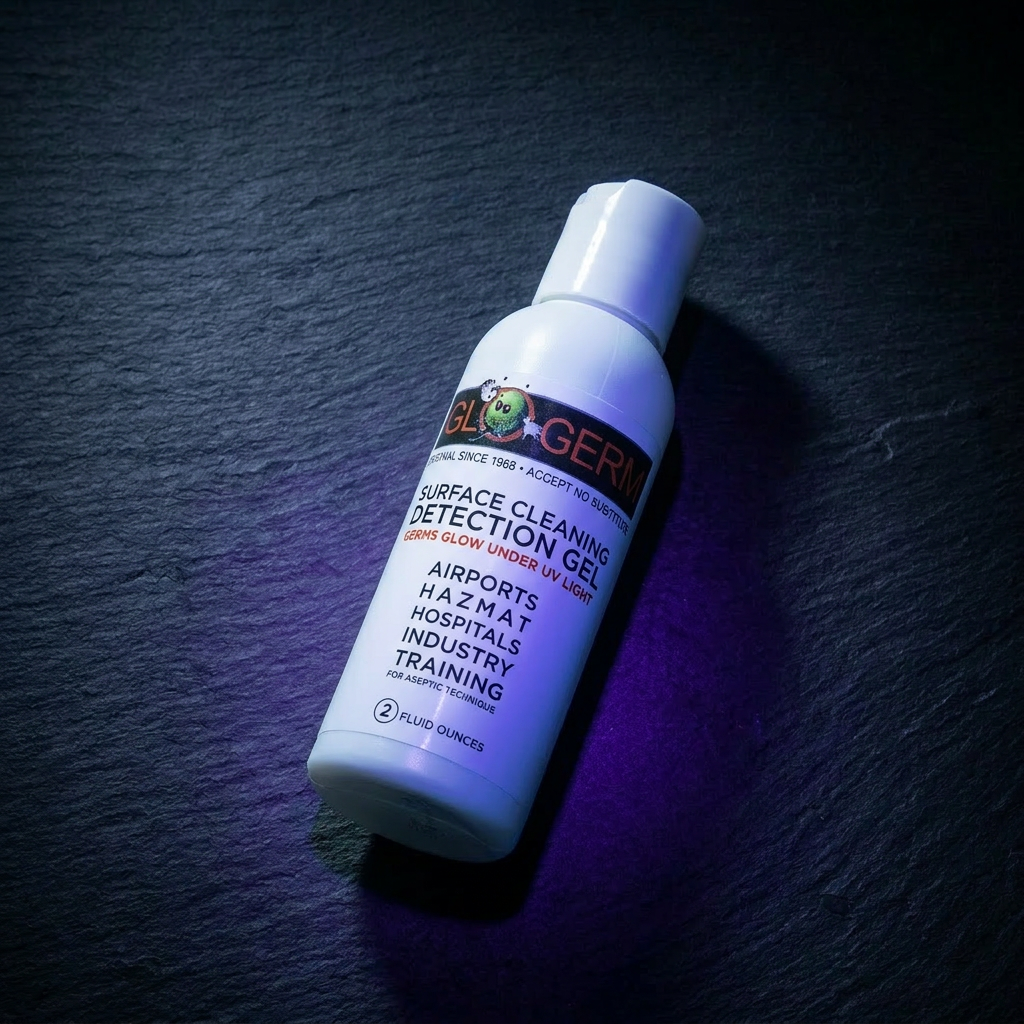
The most effective way to verify surface cleaning in hospitals is to use a UV-reactive detection gel that makes cleaning gaps visible under black light. The Surface Cleaning Detection Gel is applied to high-touch surfaces before cleaning, dries invisible, and fluoresces under UV wherever the cleaning process missed — giving infection control teams objective, repeatable evidence instead of relying on visual inspection alone.
This page is part of the How to Improve Hand Hygiene Compliance in Hospitals guide.
How does the Surface Cleaning Detection Gel work?
Healthcare-associated infections remain one of the most persistent challenges in patient safety. A significant number of these infections are linked to inadequately cleaned environmental surfaces — bed rails, call buttons, IV poles, tray tables, and bathroom fixtures that look clean to the naked eye but harbour harmful organisms.
The problem is not a lack of effort. Housekeeping teams work hard. The problem is that cleaning is invisible work, and without an objective verification method, there is no reliable way to know whether a surface has been thoroughly cleaned or simply wiped over.
The Surface Cleaning Detection Gel takes a different approach from standard GloGerm. Instead of simulating germs on hands, it is applied to high-touch surfaces before they are cleaned. The gel dries clear and becomes invisible to the naked eye. After the cleaning team performs their routine, an infection control practitioner inspects the surfaces under UV light.
Any gel that remains visible under UV means that surface was not adequately cleaned. The fluorescent residue shows exactly which areas were missed — not in vague terms, but with precise, visible evidence.
How do you set up a surface cleaning audit?
- Select target surfaces: Focus on high-touch areas in patient rooms — bed rails, overbed tables, call buttons, light switches, bathroom grab bars, and toilet flush handles
- Apply the gel: Place small dots of Surface Cleaning Detection Gel on each target surface. Use a consistent pattern so you can track results across rooms
- Allow cleaning to proceed normally: Do not inform the cleaning team which rooms are being audited. The goal is to measure actual performance, not best-case behaviour
- Inspect under UV: After cleaning is complete, use a UV lamp to check each marked surface. Document which surfaces still show fluorescence
- Calculate your thoroughness score: Divide the number of clean surfaces by the total number of marked surfaces to get a percentage compliance rate
What does the audit data tell you?
Most facilities that run their first audit are surprised by the results. Industry research consistently shows that standard terminal cleaning achieves thoroughness rates well below what most administrators expect. The most commonly missed surfaces tend to be the ones patients touch most often — call buttons, bed rail edges, and bathroom fixtures.
The value is not in catching mistakes. It is in identifying patterns. If the same surface types are consistently missed, that points to a training gap or a workflow issue that can be addressed systematically.
How do you use audit results to improve cleaning?
- Share findings constructively: Present results to housekeeping teams as a learning opportunity, not a reprimand. Show them the UV evidence so they can see the gaps themselves
- Adjust cleaning checklists: If certain surfaces are routinely missed, add them as explicit line items on room cleaning checklists
- Repeat audits regularly: Run verification cycles monthly or quarterly to track improvement over time
- Benchmark across units: Compare thoroughness scores between departments to identify where additional training is needed
Can surface cleaning verification be used outside hospitals?
While the Surface Cleaning Detection Gel was developed for healthcare settings, it is equally effective in any environment where surface cleanliness is critical. Long-term care facilities, dental clinics, food processing plants, and pharmaceutical cleanrooms all benefit from objective cleaning verification.
The HAZMAT Kit includes the Surface Cleaning Detection Gel alongside standard GloGerm products, making it a comprehensive toolkit for facilities that need both hand hygiene training and surface cleaning audits.
Start verifying cleaning compliance
The Surface Cleaning Detection Gel gives your infection control program objective, visual evidence.
Shop Detection Gel View HAZMAT Kit